
Concessions are not gifts. They’re trades. Stop giving them away.
The art of breakthrough negotiations, improving your skills of expectation management & deal making by reading these articles and then practicing by interactive simulations

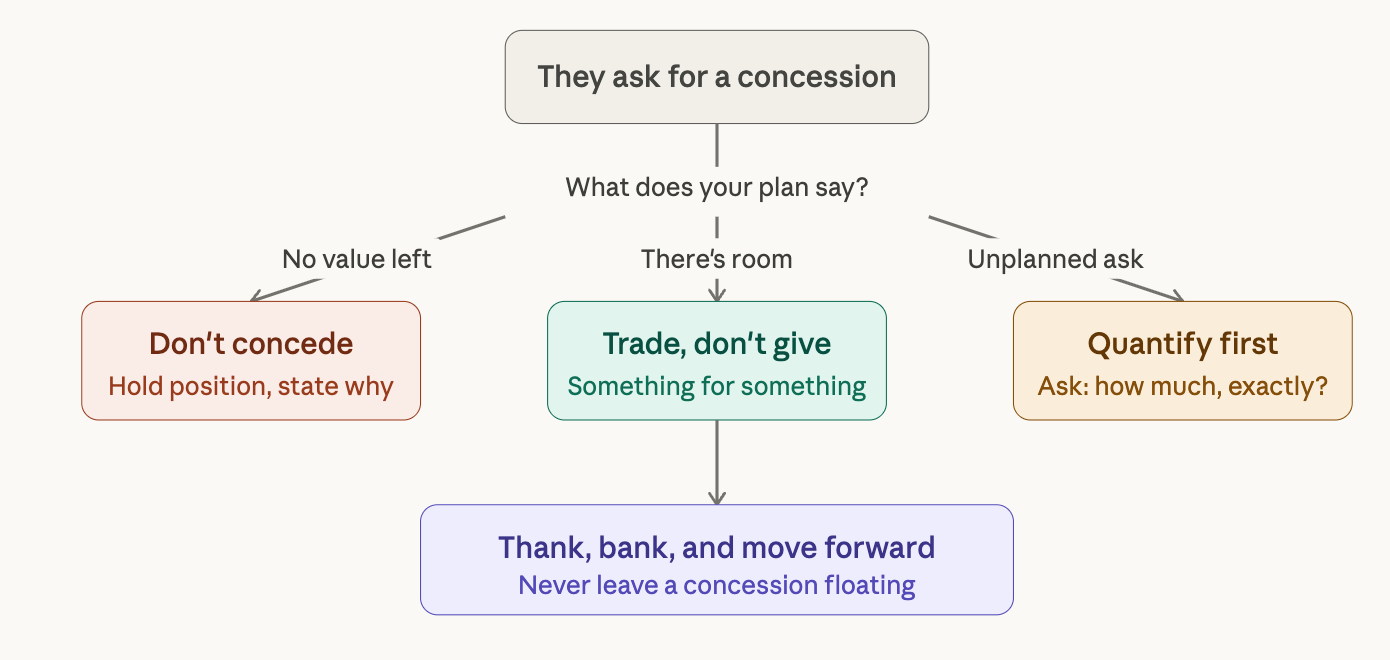
Most negotiators have a concession problem. Not that they give too many (though they do) but that they give them wrong. Unplanned, untracked, too fast, too cheap, and with nothing attached.
A concession handed over freely is just a price cut with extra steps. It tells the other side you have room. It tells them to keep asking. And it sets a pattern that runs through the rest of the negotiation like a leak in a hull… slow, then catastrophic.
The four moves. Only four.
When someone demands a concession, you have exactly four options: decline entirely, give them what they asked for, give them less of it, or give it conditionally in exchange for something back. That’s the full decision tree. There is no fifth option that involves panicking, splitting the difference reflexively, or offering something unprompted to ease the tension.
The concession strategy is the least planned-for and most avoided component of negotiation preparation, which is exactly why this is where most negotiations are lost, not at the opening offer.
“Something for something” is not a tactic. It’s a posture.
Every concession has hidden leverage inside it. The moment you give something, you have already demonstrated that movement is possible. The question is whether you extracted value in exchange, or just donated it.
Within any concession there is an opportunity to leverage a benefit in return, so concessions represent a source of power. The move is simple: make your trade conditional. “I could consider that, but if I did, I’d need X in return.” This isn’t aggressive. It’s how every functioning market works. It’s how children negotiate by age five. The problem is that adult professionals somehow unlearn it under social pressure.
Use hypotheticals to float it without locking in: “It’s possible I could give X, but if I did, would you provide Y and also Z?” You’re testing, not committing. That’s not weakness, it’s precision.
Watch your speed. It signals everything.
Speed is one of the most powerful signals to the other party of how much you need to cut a deal. A fast concession reads as desperation. It tells the room you had more room than your opening position suggested. And once that perception is established, it cannot be walked back.
The rule of halves gives you a way to read their speed too. When counterparts are conceding, they tend to halve the gap between their stated position and their limit repeatedly, each move smaller than the last, never quite reaching the floor. Map the pattern. The trajectory is the information.
Name every concession before you give it.
When you do move, make the value visible. Don’t quietly adjust a number and hope they notice. Explicitly quantify what you’re giving, frame it as significant, and track the running total. Use this to summarize how much has been given at key points in the negotiation as a means to resist further concessions.
This serves two purposes. It prevents the other side from treating your movement as the new baseline and immediately asking for more. And it creates a ledger, a record you can point to when the next demand arrives: “We’ve already moved substantially on three points. What are you prepared to give?”
Don’t lock the door behind you.
Here’s the move most negotiators miss. Avoid making firm agreements when trading concessions and instead try to hold doors open. Signal agreement in principle, “that feels workable,” rather than a closed commitment. Keep everything provisional until the full picture is on the table.
Why? Because circumstances change. New information surfaces. The other side’s position shifts. And sometimes you need to bring a previously settled issue back into play to create negotiating room. Do this by finding a reason to bring it back, perhaps as a result of their new position or because something has changed.
This isn’t bad faith. It’s the acknowledgement that a negotiation is a system, not a sequence of isolated decisions. Locking every point as you go removes flexibility and hands the other side structural advantage.
The pattern underneath all of it
Every one of these techniques points at the same underlying truth: concessions are not moments of generosity. They’re moves in a system. The negotiator who plans their concession strategy in advance, who knows what they’ll give, when, at what pace, and in exchange for what, is playing a fundamentally different game than the one who improvises.
The one who improvises usually loses. Slowly, then all at once.
Build the plan. Work the plan. And when they ask for something, pause before you answer. That pause is where your leverage lives.
Show your support
Do you like what you read?
I do write with passion and every post on Socio-Technical Criteria takes several days of research and (re)writing.
Your support with small gestures (like, reshare, subscribe, comment,…) is hugely appreciated!